
In an insect rearing facility, disease rarely announces itself clearly. Larvae grow a little slower, one rearing unit loses more individuals than the rest, fewer larvae reach the pupal stage. By the time the pattern is obvious, the problem has often spread across the facility. And unlike in livestock, most insect pathogens are poorly described, so a standard diagnostic panel may simply have nothing to look for.
What you get
- An unbiased screen of bacteria, viruses and fungi (including microsporidia) in your insects
- A comparison of symptomatic and healthy individuals, so candidate pathogens stand out from the normal microbiota
- Relative abundance of each candidate, supported by the scientific literature
- Clear recommendations for confirmation, monitoring and management in your rearing units
How we find the cause
We work from a simple design: insects from affected units are compared with insects from healthy units of the same colony. We extract total RNA and sequence the metatranscriptome, which tells us which microorganisms are active in the insect, not just present. Reads are analysed with Cucare’s in-house pathogen database and bioinformatic pipeline, and also assembled de novo, which allows us to detect viruses that have never been described before. Once a pathogen is known, we develop targeted qPCR assays to quantify pathogen loads and monitor your colonies routinely, so the next outbreak is detected before symptoms appear.
Why Cucare
Our team combines insect pathology, molecular biology and bioinformatics under one roof, with a research background in insect viruses and microbiomes built at the Universitat de València. That means we can design the sampling, run the analysis and interpret the results in the context of your production system, and report them in a way that production managers can act on.
Case report: mortality in a black soldier fly facility
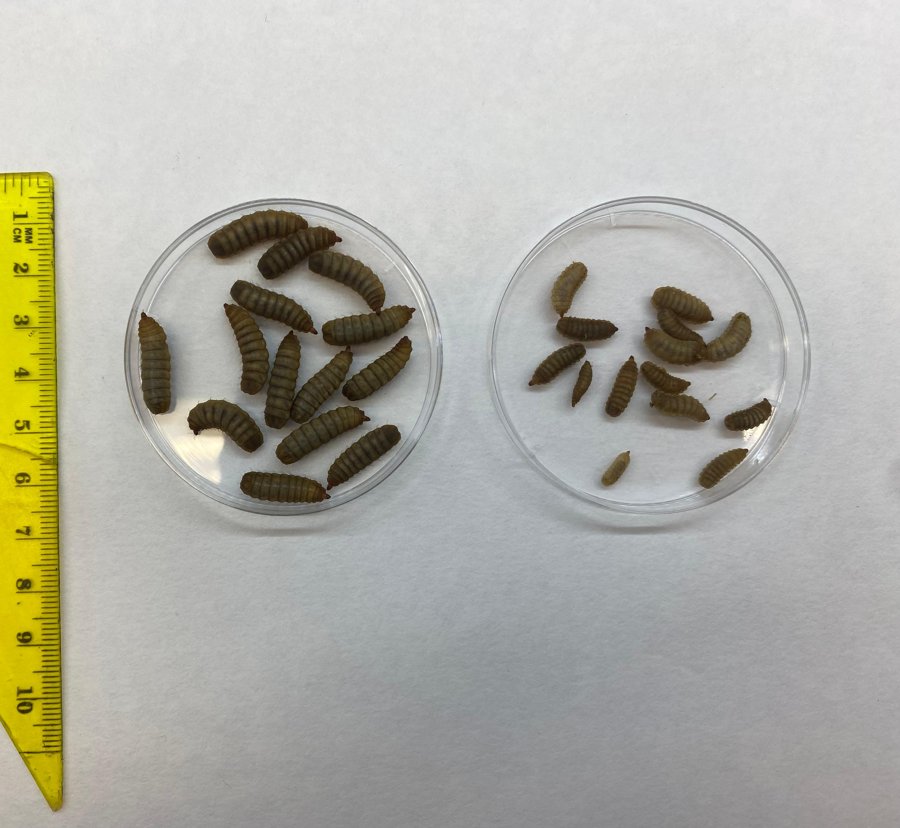
An industrial Hermetia illucens facility contacted us after observing increased larval mortality, discolouration and reduced growth in specific rearing units, while neighbouring units remained healthy. We analysed symptomatic and asymptomatic larvae in triplicate. One bacterial species of the genus Paenibacillus was around 18,000 times more abundant in symptomatic larvae than in healthy ones, while no viral or fungal agent was found at elevated levels. The facility received a clear lead candidate and a plan of next steps: isolation and confirmatory bioassays, a review of temperature, substrate moisture and sanitation in the affected units, and routine monitoring across all units.
Seeing unexplained mortality or reduced performance in your colony? Write to us and we will help you design the sampling. More about this service.