
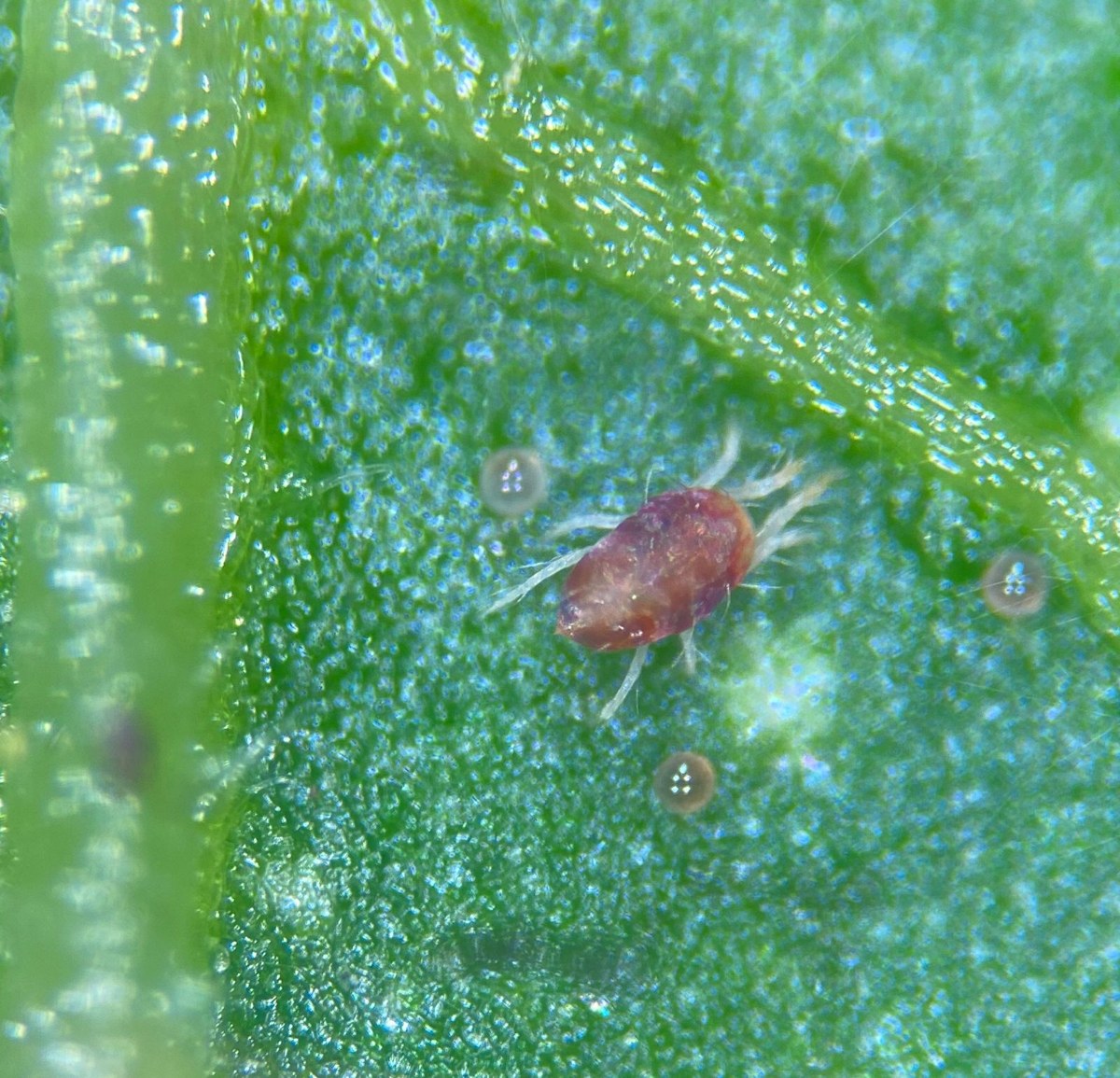
A product that used to control a pest well starts to fail. Doses go up, applications are repeated, costs rise and the pest is still there. Very often the cause is resistance: each use of the same mode of action selects the individuals that survive it, and within a few generations they make up most of the population. The two-spotted spider mite (Tetranychus urticae), with its short life cycle and high reproduction, is a textbook example of how fast this can happen.
What you get
- The susceptibility of your pest populations to the active ingredients you use or plan to use
- Dose-response curves and lethal concentrations (LC50) for each population, so sites can be compared
- Molecular detection of known resistance mutations, as a complement to the bioassays
- Practical guidance on which chemistries to keep, rotate or replace
How we work
Everything starts with the field. Samples of the pest are sent to our laboratory, where we establish each population in rearing under controlled conditions. This gives us enough individuals of similar age and condition to test them fairly. We then run dose-response bioassays: groups of individuals are exposed to a range of concentrations of the active ingredient, with replicates at each dose, and mortality is recorded and analysed statistically to estimate the lethal concentrations. When resistance is linked to known mutations, we can also detect them directly with molecular tests.
Why Cucare
Our team combines pest rearing, bioassays and molecular diagnostics in the same laboratory at the Parc Científic de la Universitat de València. We rear every population ourselves, following in-house protocols, so results from different sites and seasons are produced under the same conditions and can be compared. We work with pests of agriculture, livestock and apiculture, and report results in a way that growers, advisers and agrochemical companies can act on: which products still work, where, and at what dose.
Knowing which chemistries are losing efficacy helps you rotate modes of action, keep effective products working for longer and rely less on broad-spectrum treatments.
Case report: spider mite monitoring across Southern Europe
In 2026, an agrochemical company asked us to assess the susceptibility of two-spotted spider mite field populations to one of its acaricides. We received populations from crop sites in Europe, established each one in rearing at our laboratory and tested them with dose-response bioassays under the same protocol. Results are reported site by site, so the company can see where the product continues to perform and where resistance may be building up, and plan its recommendations accordingly.
Is a treatment losing effect in your crop, or do you need resistance data for a product? Write to us and we will help you plan the sampling. More about this service.